
Modes and scales can be confusing to the bass player. I know they befuddled me for years!
In this lesson, I'm going to teach you to make music with a mode of the the harmonic minor scale: Dorian #4.
Don't be put off by the funny name or the fact you might think it's too difficult for you. The point of this bass lesson is to create and I promise you will be doing just that by the end of it.
Scroll down for the free backing track and scale shape PDF.
If you want to master music theory and see how it will unlock your creativity, check out my course Music Theory For Bass Players.
Bass Backing Track & Mode Shape PDF
Music Theory For Bass Players
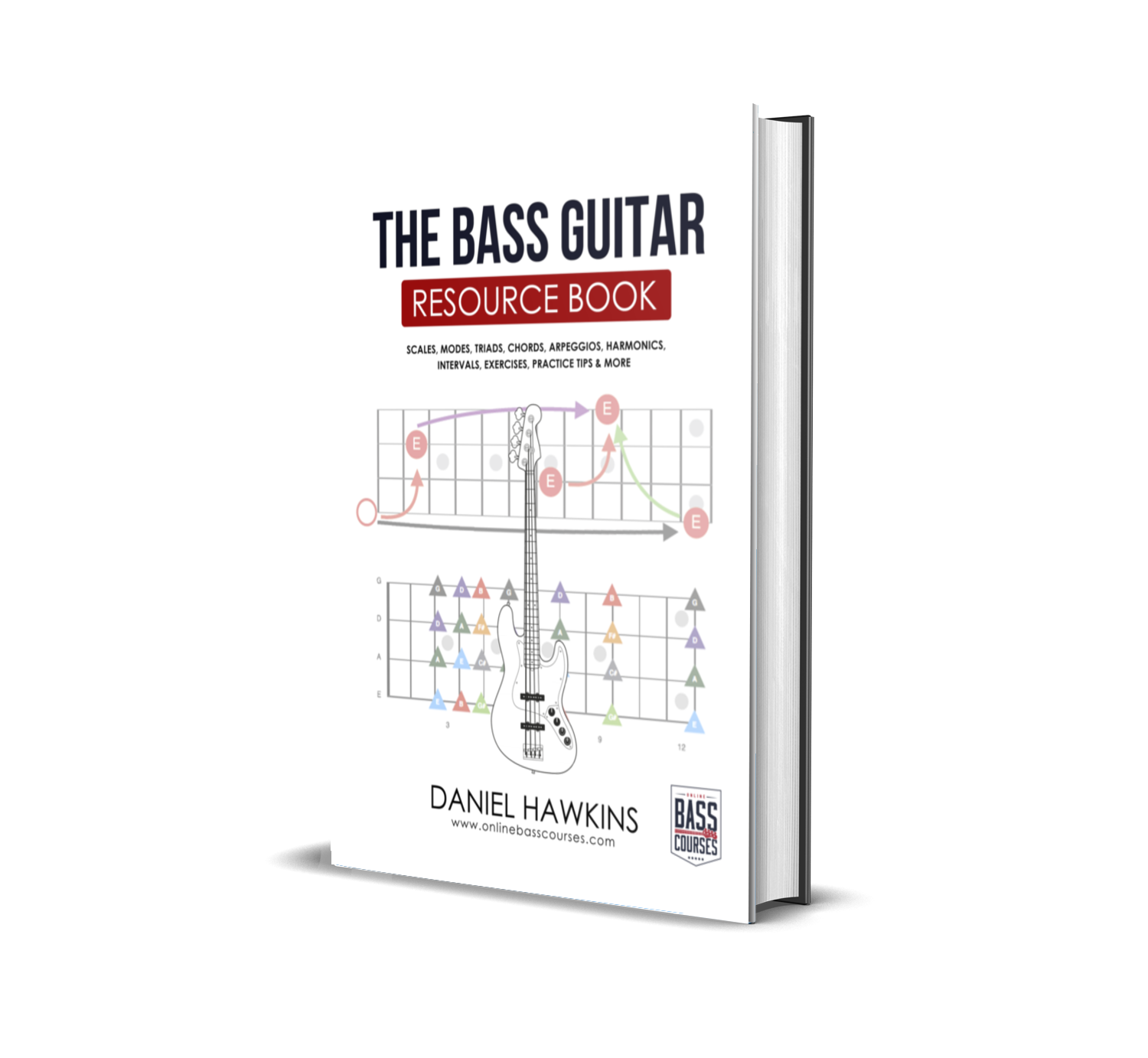
It's important to know any scale shape all over the neck, not just in one octave. My comprehensive theory course Music Theory For Bass Players contains all the major scale, harmonic minor, melodic minor modes in all positions.
There are also minor and major pentatonic, natural minor, and other bass scales, arpeggios, triads, chords, and much, much more!
Scroll down the sales page to browse all the lessons (click image below).

Hi Dan, I’ve been following you for a while now and have a few of your courses. Really learn a lot. Thanks!
Many thanks for the comment, Randy! So happy to hear that. Let me know if you have any other bass questions. Dan
Very Interesting Dan. Just starting to get a handle on the modes. What would cause me to consider playing a song in D in D Dorian? Would it be a particular feel I was going for?
I would guess that each of the modes has a particular feel but I’m far away from being able to classify them by sound/feel.
Great question. It’s more that every mode or scale has an associated chord. So it comes down to the harmony and chord progression. A static minor chord (like in So What by Miles Davis) calls for the Dorian mode as do a lot of funk jams in E Minor.
Dorian #4 is a bit more specialized and unusual. This is a good one to write with or to come up with something unusual.
So, to follow up, I choose D Dorian because “I like” the sound of the sharp 6th instead of the minor 6th?
Otherwise, the basic chord tones, 1, 3, 5 and 7th are all the same as they are in D Aeolian.
That’s correct.
I understand your bit about Dorian #4 and its interesting “sound”. To clarify my question below, as a composer I’d chose D Dorian because I liked the sound of the #6? (As the bass player I’d choose D Dorian because that’s what the song called for 🙂
Yes. You like the sound the modes and associated chords sound so you use them.
Dan, one more question and then I’ll leave you alone. If the song is in D Aeolian, could I, as the bass player, play in D Dorian or D Phrygian, looking for unique sound? Or would that just sound “weird” and clashing with the #4 or the flat 2nd?
Thanks for your insights in all your postings.
Whatever you do, don’t do it, your bandmates will fire you! In all seriousness, it will probably sound ‘wrong’ or ‘weird’ in most musical situations. There are probably situations in which it might or can work but stick within the harmony unless you’re playing jazz, where you can choose multiple options over (for example) an altered dominant chord. D Aeolian screams pop or rock and you don’t want to be messing around with #6 or b2 notes there if the key is natural minor.