
The simple idea alluded to in this lesson's title is to use various scales, modes, and pentatonics to create bass lines and fills. I've been using these musical components for decades, and they really do give you what you need to get creative.
If you scroll down, I've provided you with a free PDF with the TAB and notation from an exercise you can use to learn all the modes and their corresponding pentatonics from G Major. You should move this to different keys.
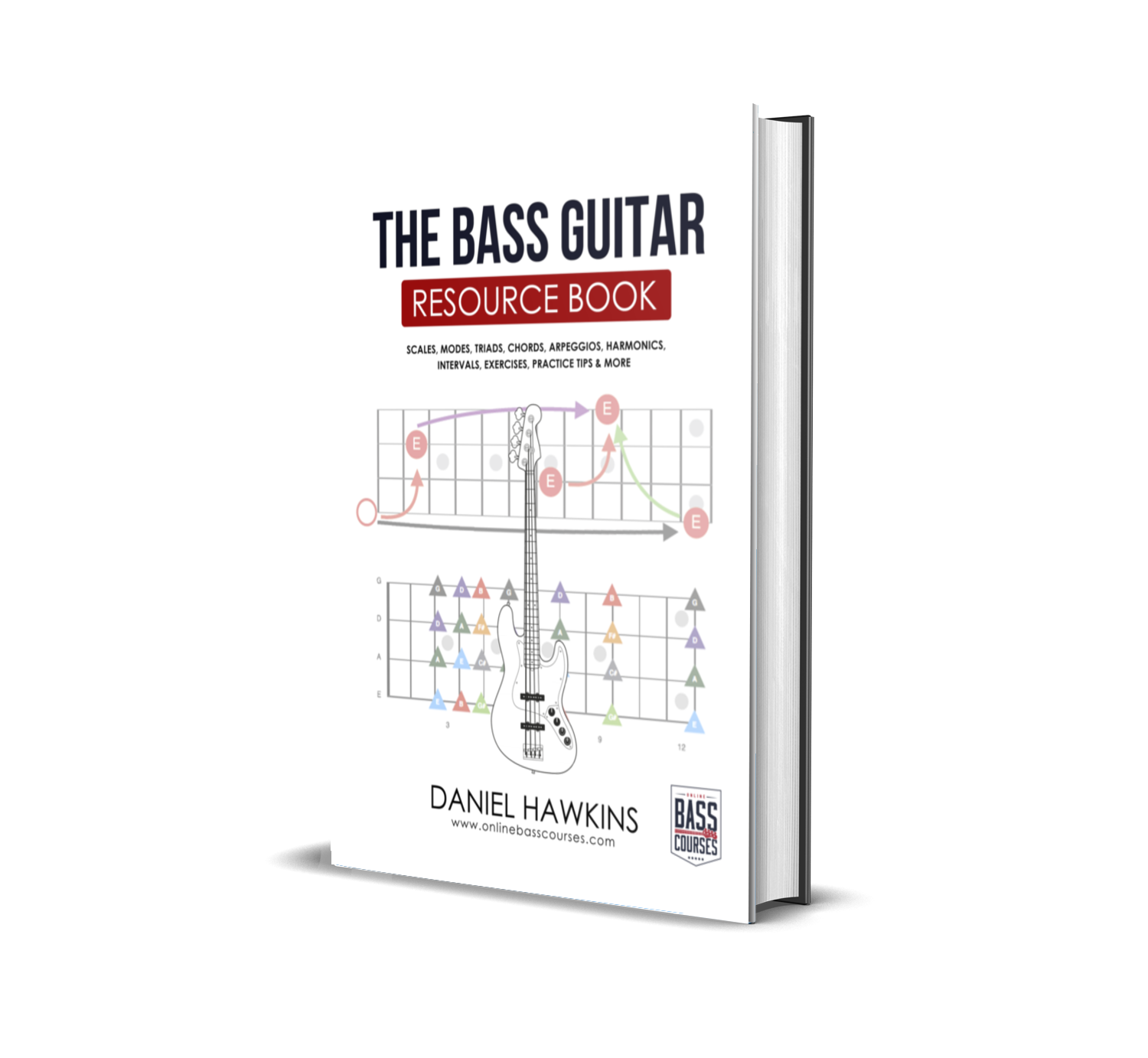
The exercise comes from a book of bass guitar exercises I wrote years ago.

Scale/Mode + Pentatonic Bass Guitar Exercise
The exercise harmonises a scale. On each degree of the scale, you play a mode (the notes of the parent scale - G Major in this example - starting on each of the different notes of the scale) ascending, and then a pentatonic scale descending.
The pentatonic is minor or major depending on the mode.
The course Music Theory For Bass Players explains all this in much more detail, with examples, TAB/notation, and backing tracks.
Bass Practice
- Study the PDF and memorise the order of modes. This might take you a while, so be patient.
- Take two modes/pentatonics and make some music. E.g., take the Ionian/major pentatonic and Lydian/major pentatonic and play one bar of each. You can play it up or down as a scale first, then try to create a groove. I demo this in the lesson.
- Experiment with different combinations and rhythms.
- Use a metronome or drum loop.
- Create a song by playing chords. You find a triad by playing the 1st, 3rd, and 5th of the mode. Play those at the same time and you have a chord. This gives you chord progressions.
Resources
Music Theory For Bass Players

MUSIC THEORY
Music Theory For Bass Players
Understand how music works, then use it to create your own bass lines, fills and solos.
Always appreciate your free lessons. I cannot say enough good things about you bass courses. Thank you Dan!
Thank you so much for your long-term support, Shawn!