In this lesson, I take a fairly basic funk bass line and gradually develop it using ideas borrowed from four incredible bass players: Anthony Jackson, Nate Phillips, Bobby Vega and Mark Adams.
All four played on hits whilst still in their teens or early twenties. It blows my mind that they were so young and already playing with such authority, flair and creativity.
Scroll down for the free TAB/notation to learn about these great players and listen to the originals.
Funk Bass Resources
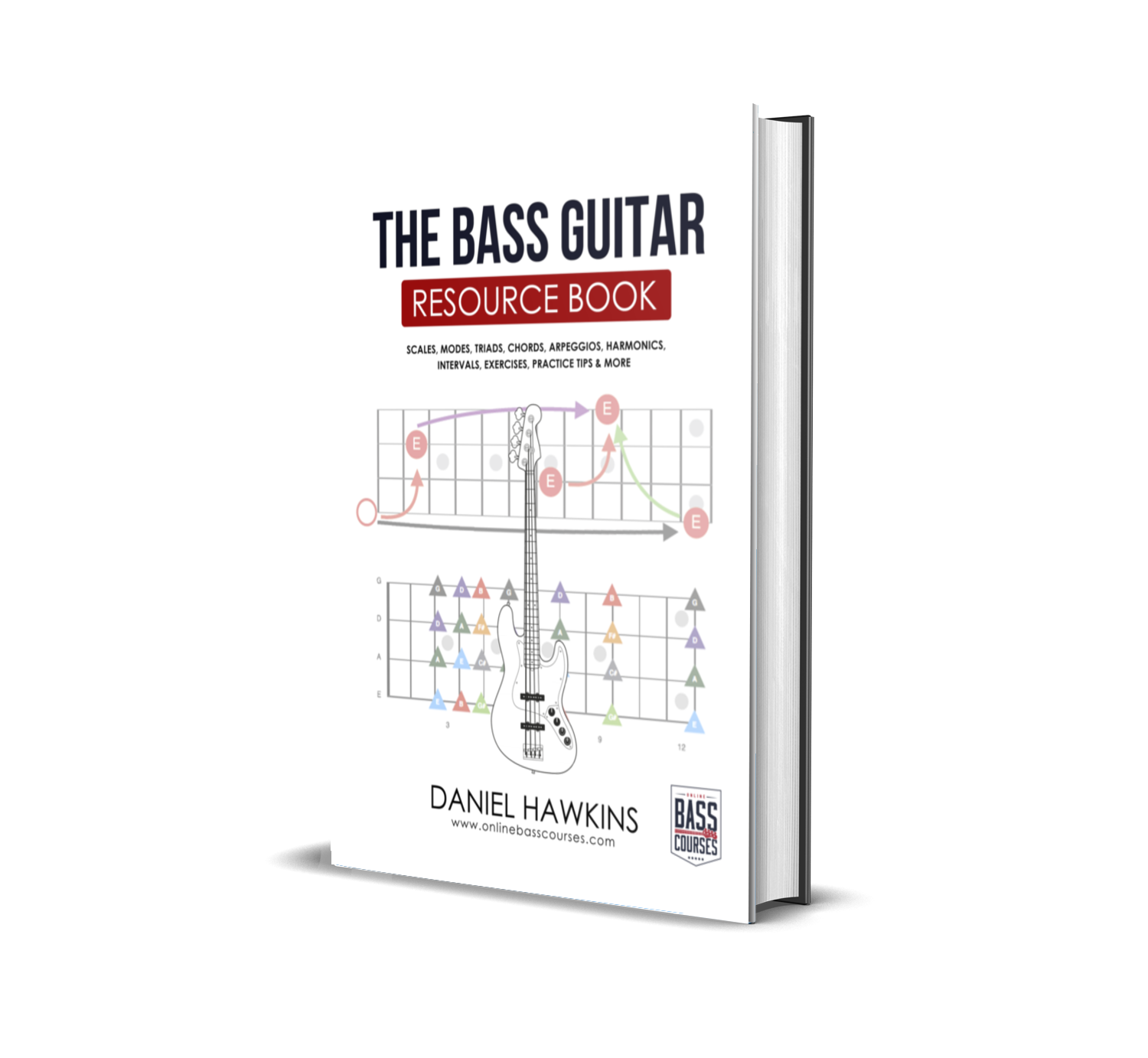
If you're eager to gain some serious funk bass chops, check out my book and/or course.
Funk Bass (Course)


One useful bass lesson every week. Unsubscribe anytime.
Funk Bass TAB/Notation
I've included the TAB and standard notation so you can follow the bass line's development and practise the techniques yourself.
Putting It All Together
By combining these four ideas, we can take a straightforward bass line and give it much more character:
- Anthony Jackson: A strong, memorable hook.
- Nate Phillips: Popped double stops for rhythmic accents.
- Bobby Vega: Simple root and ♭7 note choices.
- Mark Adams: Expressive slides and shakes.
The finished bass line is considerably more interesting than the one we started with, but every addition has a musical purpose.
Learn From the Greats
One of the best ways to improve as a bass player is to listen closely to great musicians and work out what makes their playing so effective.
Don't just learn the notes. Pay attention to their timing, articulation, note lengths, dynamics, and how they interact with the rest of the band.
Then you can take those ideas and use them in your own playing.
1. Anthony Jackson – For the Love of Money (The O'Jays, 1973)
Anthony Jackson was one of the most influential bass players of his generation. He began working professionally in his teens and went on to record with artists including Steely Dan, Chaka Khan, Paul Simon and Donald Fagen. He also pioneered the six-string contrabass guitar.
One of his most famous recordings is The O'Jays' For the Love of Money, recorded in 1973 when Jackson was 21. His distinctive bass part was so important to the song that he received a songwriting credit.
The idea I'm borrowing: A memorable hook.
Listen to the opening of this track. The bass line is instantly recognisable, even without the rest of the band.
A great funk bass line needs a strong musical identity, and a short, memorable hook can provide exactly that. In my example, I introduce a repeating phrase that gives the groove something for the listener to latch onto.
It's a reminder that a bass line doesn't have to be complicated to be interesting.
2. Nate Phillips – Glide (Pleasure, 1979)
Nate Phillips was the bassist for Pleasure, a brilliant funk and jazz-funk band formed in Portland, Oregon, in the early 1970s. He was still a teenager when the group came together.
Pleasure released several excellent albums, but their best-known track is probably Glide, from the 1979 album Future Now. Phillips was 23 when it was released, and his bass playing is a masterclass in funk technique and rhythmic precision.
The idea I'm borrowing: Popped double stops.
A double stop is simply two notes played together. On a funk bass, popping two strings simultaneously can produce a powerful, percussive sound.
The important thing is placement. Rather than adding double stops everywhere, try using them at specific rhythmic points to complement the drums.
3. Bobby Vega – I Get High on You (Sly Stone, 1975)
Bobby Vega is a hugely respected bassist from the San Francisco Bay Area, particularly well known for his extraordinary pick playing and deep sense of groove.
He began his professional career as a teenager and landed a recording session with Sly Stone, playing on I Get High on You, which appeared on Sly's 1975 album High on You.
It's a wonderful example of how much funk can come from a relatively small amount of musical material.
The idea I'm borrowing: The root and flattened seventh.
You don't always need lots of different notes to create a great bass line.
One of the simplest funk sounds comes from moving between the root and the flattened seventh (♭7). These two notes can create a strong, bluesy character, particularly when played with good timing and articulation.
I introduce this movement into my example, using the rhythm and note lengths to make it groove.
Sometimes, restricting your note choices actually makes you play more creatively.
4. Mark Adams – Slide (Slave, 1977)
Mark Adams was the phenomenal bassist for Slave, one of the great American funk bands of the late 1970s and early 1980s.
He was only around 16 or 17 when Slave recorded their breakthrough hit Slide, released in 1977. The track features an extraordinary bass performance, full of attitude, energy and some very distinctive techniques.
Adams developed a sound that was instantly recognisable, and his playing remains hugely influential.
The idea I'm borrowing: The slide-and-shake technique.
One of the most exciting features of Adams' playing is his ability to slide into a note and then give it an aggressive, almost vocal shake.
It's an incredibly expressive sound.
In my bass line, I use this technique to add personality and excitement to a phrase that would otherwise sound fairly ordinary.
It's also a good example of something that notation alone can't fully communicate. You need to listen carefully to the original recording to understand the feel, attack and movement behind the technique.
Funk Bass Resources
If you're eager to gain some serious funk bass chops, check out my book or course.
Funk Bass (Course)