
What separates a basic bass line from one that sounds rich, expressive, and professional? The answer lies in mastering several key musical elements—note choice, groove, phrasing, and feel—that transform simple patterns into unforgettable grooves.
In this guide, we'll explore how to elevate your bass playing using a C# minor progression (C#m / F#m / A / B) as our foundation.
Start with Simplicity
Every strong bass line begins with a solid foundation. I kick off this lesson with a basic, beginner-level groove - something that feels steady but leaves room to grow. (This is from last week's lesson: Master Hand Shifting on Bass – Speed, Accuracy & Fluidity!)

Bass Shapes & Scales To Elevate Your Bass Lines
Start With a Solid Foundation
Every great bass line begins with something simple. Root notes and steady rhythm create the perfect canvas for your musical expression. From this foundation, you can layer in techniques that add depth, movement, and character.
Beyond Root Notes: Strategic Note Choice
To move past basic root-note playing, start by incorporating chord tones:
- C#m: Use C#, E, and G# (minor triad), or add B for C#m7 color
- F#m: F#, A, and C#, or include E for F#m7
- A: A, C#, and E (major triad)
- B: B, D#, and F# (major triad), or add A for dominant 7 flavor
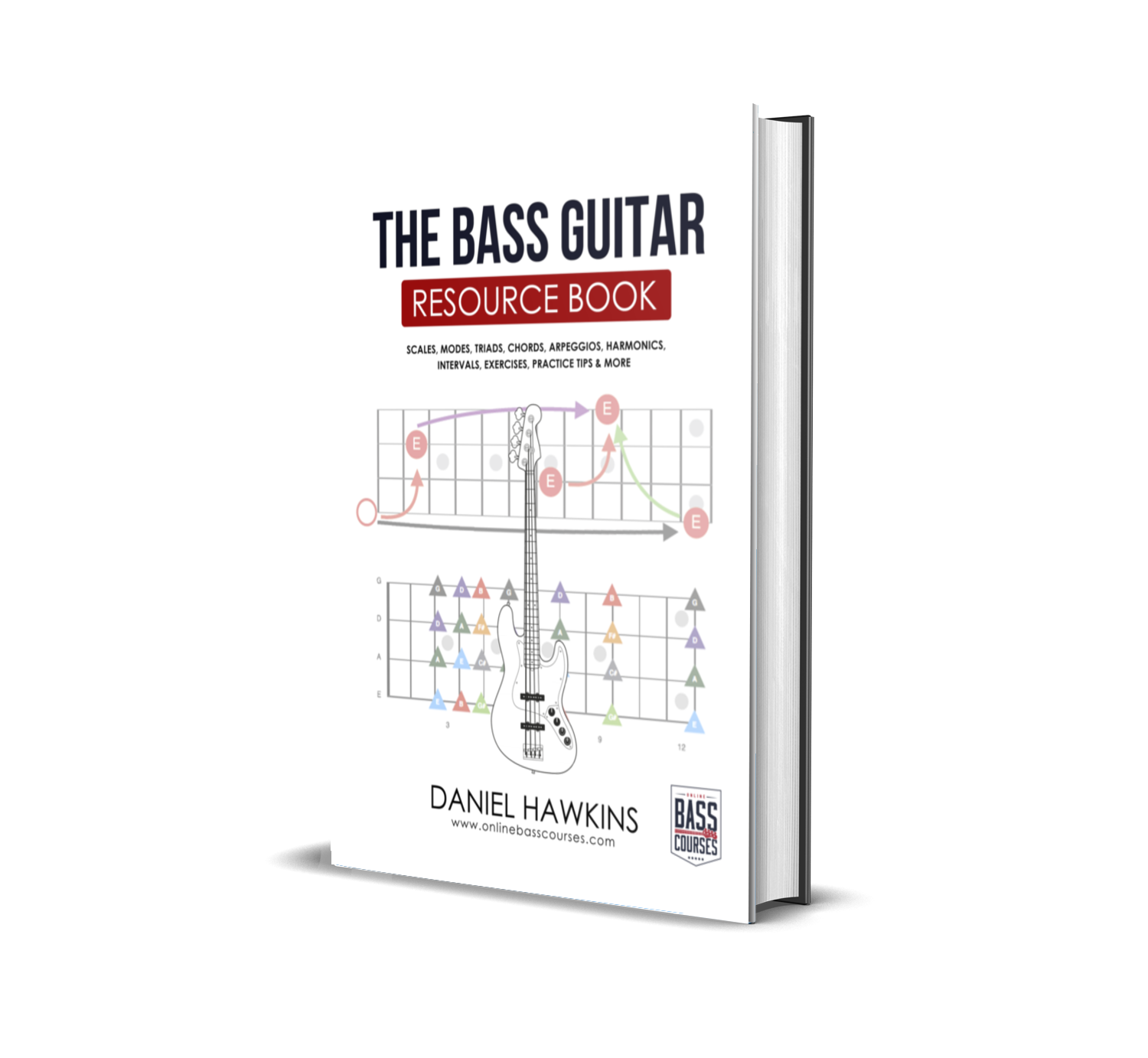
These chord tones should form the backbone of your lines. Once comfortable, embellish with passing notes and scale tones that connect these harmonic anchors. You can see all these shapes in the PDF above.
Crafting Your Groove
Professional bassists understand that rhythm is just as important as note choice. Develop your groove by incorporating:
- Syncopation
- Strategic rests
- Anticipations
- Varied subdivisions
The pulse and feel behind your notes dramatically impact the energy of your playing.
Creating Melodic Movement
Use the natural flow of the chord progression to guide your lines. Connect arpeggios melodically by stepping from one chord tone to another using scale tones. This creates a sense of journey and musical storytelling within your groove.
Expand Your Fretboard
Don't limit yourself to a single position. Practice shifting across the neck to reach arpeggios in different areas. For example:
- Learn the C# Natural Minor, pentatonic, and blues scales in more than one position (my course Music Theory For Bass Players teaches all these scales in all positions - and much more).
- Move up the neck to maintain a smooth, lyrical feel
This approach opens new sonic possibilities and gives your lines more range and expression.
Add Modal Color
Since our progression is in C# minor, you can draw from the C# natural minor scale (C#, D#, E, F#, G#, A, B) as your foundation, but explore different modal flavors over each chord:
- C#m: C# Aeolian (natural minor)
- F#m: F# Dorian (F#, G#, A, B, C#, D#, E) for a brighter quality
- A: A major scale/Ionian
- B: B Mixolydian (B, C#, D#, E, F#, G#, A) for a dominant, bluesy feel
These modal approaches add richness and allow you to move beyond purely diatonic playing.
Expressive Techniques
To truly sound professional, focus on your articulation and dynamics:
- Ghost notes
- Slides and bends
- Hammer-ons and pull-offs
- Variations in attack strength
These subtle expressive techniques bring your bass lines to life and create that professional groove feel.
The Art of the Fill
Fills should complement your main groove, not distract from it. Use them thoughtfully to:
- Bridge sections
- Answer melodic phrases
- Build energy toward transitions
Remember: a well-placed fill enhances the groove; too many can derail it.
Incorporate Harmonics
Natural harmonics add sparkle and interest to a bass line. Use them for accents or as a contrasting texture within repetitive grooves. Even simple harmonics in strategic places can transform your sound.
Explore Chords and Double Stops
Adding chords or double stops (two notes played simultaneously) gives your lines harmonic weight. Try double stops using thirds or sixths from the C# minor scale to add subtle movement or emphasize important transitions.
- Bass ‘Double Stops’ – What Are They & How To Use Them
- Bass Chords: Tutorial on Technique, & Soloing (Minor Scale)
Building Your Pro-Level Groove
Apply these techniques one at a time—focus on note choice, then groove, then melody, and so on. With practice, you'll integrate these elements naturally, turning even the simplest groove into something musical and memorable.
Ready to Take Your Bass Playing Further?
If you're excited to master these techniques, my comprehensive course From Beginner to Bassist will help you build a complete foundation for confident, creative bass playing. You'll learn all the concepts covered in this lesson and how to apply them across various styles and musical situations.
I wish I got this lesson years ago. I feel like I just got the keys to my first car.
Glad you enjoyed it, Jeff!
Thanks Dan ! Great stuff.
Cheers, David!