
Modes can feel mysterious when you first encounter them.
You might have learned the names — Dorian, Phrygian, Lydian — but still wondered:
How do I actually use these in real bass lines?
That’s what this lesson is about.
In this post, I’ll give you a practical overview of modes and show you how I use them in this lesson to create colour, feel, and movement on the bass.
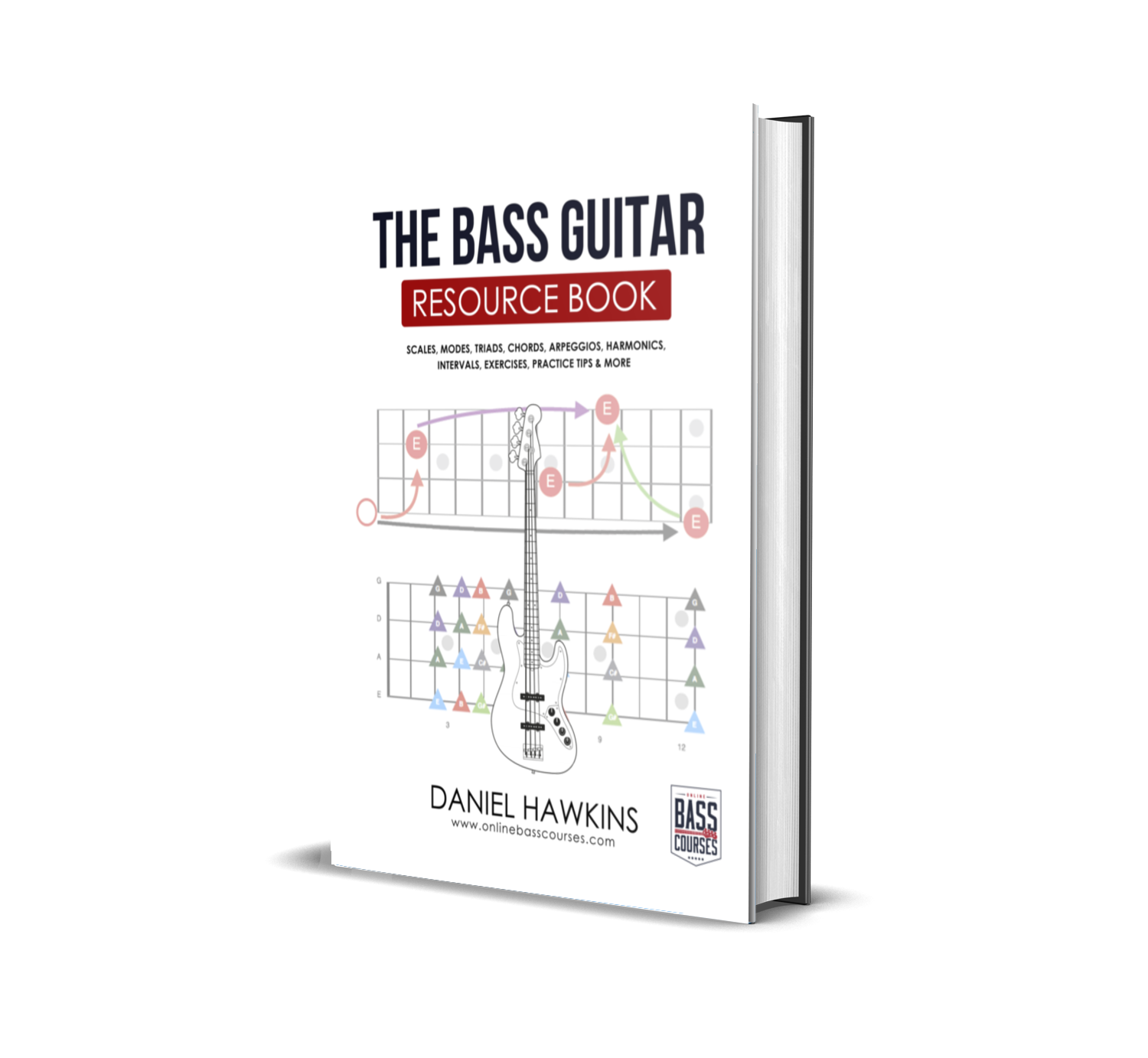
If you want a deeper, structured understanding of how modes connect to keys, harmony, and real-world bass playing, my Music Theory For Bass Players course walks you through everything step by step so you’re not just memorising shapes — you’re making music with them.

Bass Mode Patterns & Backing Tracks
Here are the two backing tracks for this lesson:
The first is to be used with the Phrygian Dominant mode. In this example, I show you the triads that you can form from that mode and how to play over them. This is the chord progression:
E7 / E7 / FMaj7 / FMaj7 / E7 / E7 / Dm7 / Fdim7
And this is the backing track:
This next one is for the Super Locrian mode (AKA 7th mode of the melodic minor, altered scale, or diminished whole tone!). Use it over the E7 chord - that's where the magic happens with this mode; over altered dominant chords.
This is the chord progression:
Bm7 / Bm7 / E7alt / E7alt / AMaj7 / AMaj7 / AMaj7 / AMaj7 /
Here's the backing track:
Here's a PDF with all the shapes from the lesson:
What Are Modes (In Simple Terms)?
Modes are simply subsets of a major scale (or melodic minor or harmonic minor).
If you take a major scale and start on a different note — but keep the same notes — you create a new sound with its own flavour and emotional quality. This all happens because the interval formula is changed each time; it is no longer the same scale if you start on a different degree.
For bass players, modes aren’t about sounding clever. They’re about:
- Creating mood
- Supporting harmony properly
- Making grooves feel right
- Adding tension or lift when needed
Each mode has a unique tonal centre and characteristic intervals that give it its identity.
Let’s look at how I use them musically in this lesson. These are all ideas you can use next time you pick up your bass.
Lydian Mode (With a Drone)
The lesson begins with Lydian over a drone. Download drones in all 12 keys here.
Lydian is like a major scale with a raised 4th. That one note changes everything.
That sharp 4 creates a floating, open, almost cinematic sound. Over a sustained drone note, you really hear the colour of the mode rather than just running up and down a scale.
As a bass player, this teaches you something important:
You’re not just outlining chords — you’re shaping atmosphere.
Lydian works beautifully in:
- Ambient textures
- Film-style harmony
- Dreamy major progressions
- Sections that need lift without tension
It’s subtle, but powerful.
This is a brilliant example of a drone over a Lydian mode. The incomparable Joe Satriani:
Dorian Mode – FUNK
Dorian is one of the most useful modes for bass players.
It’s essentially a natural minor scale with a major 6.
That major 6 is the magic note.
In funk settings, Dorian gives you:
- Minor tonality
- Groove-friendly colour
- Space for syncopation
- Classic funk flavour
Think of countless minor funk grooves — Dorian sits perfectly because it supports minor harmony while still sounding optimistic and rhythmically alive.
On bass, it allows you to:
- Outline minor chords clearly
- Use the 6th for melodic movement
- Add fills that sound intentional rather than random
This is a workhorse mode.
Dorian Mode – ROCK
The same mode can behave differently depending on the style.
In rock, Dorian feels more driving and grounded.
Because rock often leans into power chords and strong root movement, Dorian gives you:
- Minor weight
- Melodic flexibility
- Strong mid-range movement
Instead of focusing on groove subtleties like in funk, here you might:
- Emphasise root–flat 7–minor 3
- Use the 6th sparingly for lift
- Build strong, repeatable motifs
Same notes. Different attitude.
That’s the key lesson.
6:00 by Dream Theater contains a brilliant rock Dorian riff.
Phrygian Mode
Phrygian is darker.
It’s a minor scale with a flattened 2nd — and that flat 2 is unmistakable.
It creates:
- Tension
- Drama
- Spanish or Eastern flavour
- Aggression when used rhythmically
On bass, Phrygian works well when:
- The harmony sits firmly on a minor chord
- You want a slightly exotic feel
- You need to create a metal riff!
Used carefully, that flat 2 can define an entire section of a song.
Used carelessly, it can sound wrong.
That’s why understanding the harmony is essential.
Take The Time by Dream Theater contains another epic riff, this time Phrygian:
Phrygian Dominant Mode
Phrygian Dominant takes things even further.
It’s the 5th mode of the harmonic minor scale and contains:
- A major 3rd
- A flat 2
- A dominant sound
This combination gives you a bold, dramatic, almost flamenco-inspired flavour.
On bass, this is fantastic when:
- You’re outlining a dominant chord
- The music has Middle Eastern or Spanish character
- You want tension before resolution
It’s not an everyday sound — but when it fits, it really fits.
Altered Scale (7th Mode of the Melodic Minor)
The altered scale is all about tension.
It’s built from the melodic minor scale and is commonly used over dominant chords that are about to resolve.
It contains altered tensions like:
- Flat 9
- Sharp 9
- Flat 5
- Sharp 5
This makes it ideal for:
- Jazz-influenced harmony
- Turnarounds
- Dominant chords that need a strong pull
- Creating tension before release
As a bass player, you don’t need to use every note.
Even targeting one altered tone can transform a simple dominant chord into something much more expressive.
How to Actually Use Modes on Bass
Here’s the most important point:
Modes are not exercises.
They are tools.
To use them well:
- Start with the chord.
- Understand the harmony.
- Choose the mode that fits that harmonic context.
- Build grooves and lines from chord tones first.
- Use characteristic notes for colour.
- LISTEN to music that contains modes. This provides the all-important context needed to solidify learning.
Don’t just run scales.
Create phrases. Create rhythm. Create movement.
That’s how modes become musical.
Final Thoughts
Modes give you colour.
They give you options.
They help you understand why certain bass lines sound right — and why others don’t.
In this lesson, I show you practical ways to use Lydian, Dorian (in two different styles), Phrygian, Phrygian Dominant, and the Altered scale in real musical situations.
Once you understand modes, you’ll start hearing modes everywhere.
In my Music Theory For Bass Players course, I cover modes in greater detail, including shapes across the neck and in all keys for the melodic minor, harmonic minor, and major scales.
Wow! Thank you, Dan! You did it again, another great lesson!
This is an excellent lesson and a must-see for any bass player wanting to improve their music/bass skills. It’s Jam-packed with real world examples, useful hints and tips, insights on the modes, and in general, all-around good bass playing technique.
Thanks,
Tim
Thank you, Tim!